

Environmental gradients and tardigrade diversity

Tardigrades are often considered exceptionally resilient, yet environmental conditions strongly influence their diversity and distribution. In two recent papers, using DNA metabarcoding and spatial modelling, our team examined how natural and human-driven gradients influence tardigrade communities.
Altitudinal gradients and microhabitat filtering
In the first study, Daniel and Bartek, with their collaborators, analyzed tardigrade communities inhabiting bryophytes across a broad altitudinal gradient in the Western Alps. Using DNA metabarcoding of 546 samples and functional trait data, they showed that species richness decreases with altitude, while phylogenetic and functional diversity increase. Importantly, although altitude and geography drive species turnover, microhabitat traits strongly shape community structure, highlighting the key role of fine-scale habitat heterogeneity in mountain biodiversity. The paper was published in Molecular Ecology and as a preprint, here. The paper is a result of the ongoing Sonatina project (2022/44/C/NZ8/00050 to Daniel), funded by the National Science Centre, Poland.
Urbanisation and the limits of tardigrade resilience
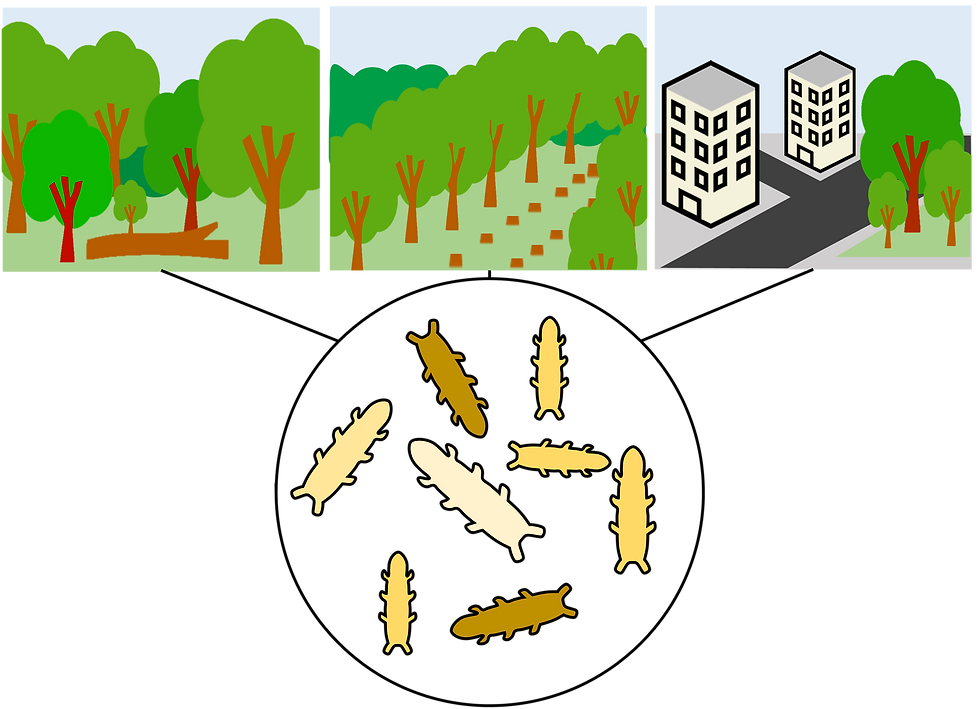
In another recent paper, Bartek, Daniel, and our interns Liza and Krystian investigated how human land use affects tardigrade diversity in tree stands with different levels of anthropogenic impact. Altered habitats supported lower species richness and highly divergent communities dominated by widely distributed taxa. The results challenge the idea that tardigrades are largely unaffected by disturbance and suggest they may serve as useful indicators of environmental change in human-dominated landscapes. The paper was published in Global Ecology and Biogeography and can be accessed here. The paper is a result of the ongoing Preludium project (2022/45/N/NZ8/01992 to Bartek) funded by the National Science Centre, Poland.


Comments